Shanghai Urban Masterplan
Masterplanned lilong regeneration where each intervention feeds 50,000 people.
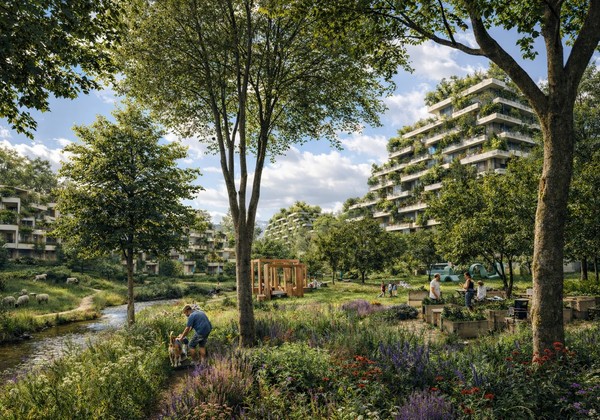
This masterplan transforms a district of downtown Shanghai adjacent to Nanjing Road into a community self-sufficient in energy, food, water and work. It takes the city's lilong social housing districts from the 1900s, then on the brink of demolition, and rebuilds around them rather than over them. New mixed-use cores are connected by reopened canals with bicycle and pedestrian routes alongside. Vertical farms clean water and air while generating energy and food. Each intervention supplies the basic food requirement of 50,000 people within a one-kilometre radius.
The Problem
Shanghai's growth was producing pollution, congestion, a housing shortage, shrinking agricultural land and runaway development at once, and the standard response was to clear the lilong districts and rebuild at density. That treats a century of social fabric as an obstacle.
Research into the lilong typology, the city fabric and the social situation on site pointed the other way. The districts were an asset whose economic and social value demolition would destroy and could not replace. The question was reframed from how much to build into how much of the existing city a single intervention could bring back into use.
Process
Convert one district to revive three
Each intervention converts a single lilong district and gives new viability to three others plus the surrounding area. Core buildings are placed within the existing typology and linked by a canal system, restoring a channel that was a defining part of Shanghai's history and carries functional and economic benefit alongside the cultural one. The new centres are mixed-use, activated by markets, cultural facilities, public gardens, retail, housing and large-scale urban agriculture.
Farm the towers, clean the creek
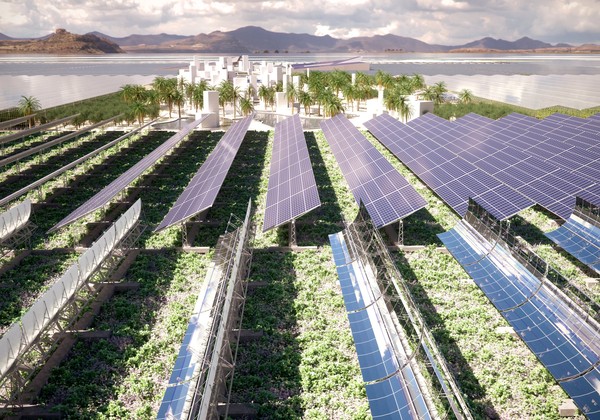
Vertical farms produce food and energy and clean water and air as they run. Polluted water from Suzhou Creek is cleaned by evaporation inside the towers and fed back into the channel system to serve districts that need clean water and energy infrastructure. Decentralised photovoltaic arrays and methane from basement biomass composting drive zero-carbon district heating.
Employ the labour that is already there
Shanghai's large, agriculturally skilled and largely unemployed workforce staffs the high-intensity vertical farms and the urban markets integrated into the converted lilongs. Local production cuts food imports and city goods transport sharply.
Outcomes
- People fed per intervention
- 50,000
- Within a one-kilometre radius of each converted district.
- Districts revived per conversion
- 1 to 3
- Each converted lilong gives new viability to three others.
- District heating carbon
- Zero
- Biogas from basement biomass composting with solar co-generation.
Gallery
Credits
Except team: Tom Bosschaert (Director).
With: Isaac Strackbein (Architect, stanton Architecture).
Except team: Tom Bosschaert (Director).
With: Isaac Strackbein (Architect, stanton Architecture).
More urban planning
Working on something with this shape?
We take commissions where systemic complexity is the central design challenge. Tell us about the place, the constraint, or the problem.