Cool Neighbourhoods
Greening 30,000 m² across nine pilot neighbourhoods to cut urban heat stress.
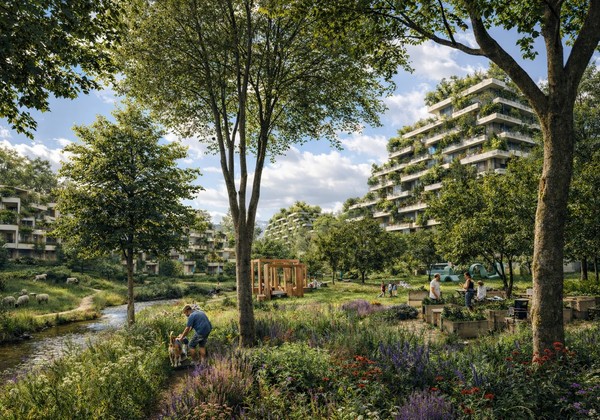
Cool Neighbourhoods addresses urban heat stress in nine pilot areas across the Netherlands, Belgium, France and Luxembourg, supported by the European Interreg North West Europe programme. Twelve European partners work with residents, policymakers and designers through a three-year co-creation process. Interventions are tailored per location and directed at the groups most exposed: the elderly, the young, small businesses, property owners and visitors. More than 30,000 square metres of public space is being greened, with a liveability index measuring impact and guiding what comes next.
The Problem
Rising urban temperatures concentrate into hot pockets within cities, and those pockets damage public health, productivity, well-being, air quality and water quality. The strategies that reduce heat stress are well known: trees, shade sails, water features. The difficulty is not the technique.
Nine neighbourhoods facing the same phenomenon face it at different intensities, with different populations, ownership patterns and budgets. A single specification applied across them would underperform in most. The project was structured to produce nine tailored plans from one shared method, rather than one plan applied nine times.
Process
Measure with the people who live there
Citizen science collects the temperature and liveability data. Residents record conditions in their own streets, which produces data at the granularity heat stress actually operates at and builds the local constituency needed to get interventions installed and maintained.
Tailor per pilot, share the method
All twelve partners co-create training programmes and neighbourhood plans, tailored to each location on detailed cost-benefit analysis. Interventions are targeted at specific groups within each community rather than applied uniformly across an area, so the households most exposed to heat are the ones the money reaches.
Count the co-benefits
Trees, shade sails and water features are selected for what they deliver beyond temperature: biodiversity, social connectivity, reduced risk and cost, and educational value. A liveability index tracks the combined effect and guides subsequent rounds of intervention.
Outcomes
- Public space greened
- 30,000+ m²
- Across nine pilot areas in four countries.
- Pilot neighbourhoods
- 9
- Netherlands, Belgium, France and Luxembourg.
- European partners
- 12
- Working together across a three-year co-creation process.
Gallery
Credits
Except team: Tom Bosschaert (Director), Emma Westerduin (Architect and Project Manager), Eranda Janku (Head of Urban Planning), Sonia Gholami (Head of research, Physicist), Amir Aubed Zoubi (Industrial Ecologist).
Except team: Tom Bosschaert (Director), Emma Westerduin (Architect and Project Manager), Eranda Janku (Head of Urban Planning), Sonia Gholami (Head of research, Physicist), Amir Aubed Zoubi (Industrial Ecologist).
More urban planning
Working on something with this shape?
We take commissions where systemic complexity is the central design challenge. Tell us about the place, the constraint, or the problem.