Middelburg Sint Laurens Sustainable Masterplan
Developed a regenerative masterplan embedding housing within productive landscapes and waterways.
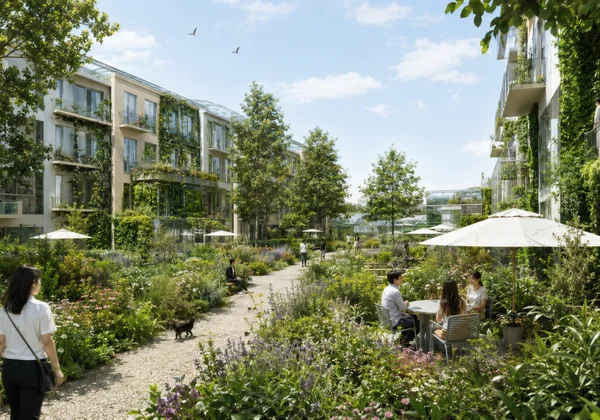
The Netherlands faces challenges in expanding its housing stock in a future-proof manner. Except Integrated Sustainability, in collaboration with the municipality of Middelburg, developed a masterplan for the expansion of Sint Laurens village that embeds housing within a regenerative landscape offering recreation, food production, and fresh water access.
The Sint Laurens masterplan utilizes the Orchid City concept for neighborhood development. Three housing clusters are interwoven across the landscape, opening up at two points on the Noordweg, where community facilities and vegetable gardens create the neighborhood's social heart.
The Problem
Sint Laurens faces challenges in water management, facilities, and soil shrinkage, while the municipality pursues ambitious sustainability targets. Standard Dutch housing expansion typically creates uniform residential zones disconnected from landscape, food production, and natural water systems. The challenge: plan a housing expansion where residents live amongst a regenerative landscape that addresses these challenges holistically, providing an inclusive, active community with access to sustainable food, water, and energy systems from day one.Process
Orchid City neighborhood model
The Orchid City model calculated a diverse program with neighborhood amenities and various housing typologies for an inclusive community. Room was allocated for sustainable production of energy, vegetables, fruits, and nuts for all residents of Sint Laurens.Landscape-led design
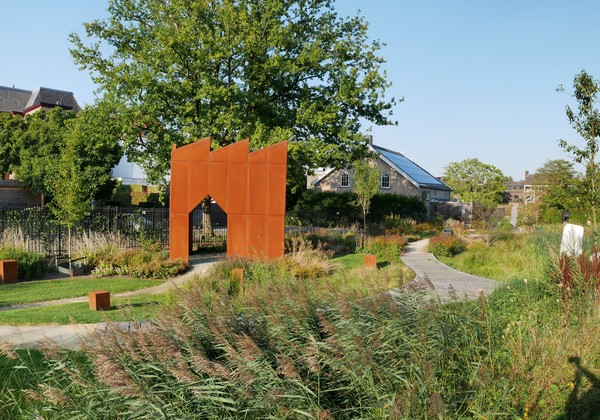
Rather than laying out streets and lots, the masterplan begins with landscape: the creek ridge ecology, water management systems, and productive agriculture. Housing clusters are then woven into this landscape framework, ensuring every resident has direct access to nature and food production.Metabolic integration
A biogas plant and greenhouses are located in the ecological zone where new aquatic habitats are created. These productive elements serve the entire neighborhood while enhancing rather than diminishing the landscape's ecological value.Outcomes
- Framework
- Orchid City
- Regenerative neighborhood development using proven systemic tools
- Food production
- Self-sufficient
- Vegetables, fruits, and nuts for all Sint Laurens residents
- Water management
- Integrated
- Creek ridge ecology and aquatic habitats woven through housing
- Community model
- Inclusive
- Diverse housing typologies with shared amenities and gardens
Gallery
Credits
Except team: Tom Bosschaert (Director), Emma Westerduin (Architect and Project Manager), Eranda Janku (Head of Urban Planning), Hannah Roberts (Research Specialist and Urban Geographer), Sandra Dilberovska (Research specialist, Environmental management), Vandhana Kannan (Architect), Khanh Nguyen (Architect and Urban Designer).
Except team: Tom Bosschaert (Director), Emma Westerduin (Architect and Project Manager), Eranda Janku (Head of Urban Planning), Hannah Roberts (Research Specialist and Urban Geographer), Sandra Dilberovska (Research specialist, Environmental management), Vandhana Kannan (Architect), Khanh Nguyen (Architect and Urban Designer).
In collaboration with municipality of Middelburg.
More landscape
Working on something with this shape?
We take commissions where systemic complexity is the central design challenge. Tell us about the place, the constraint, or the problem.