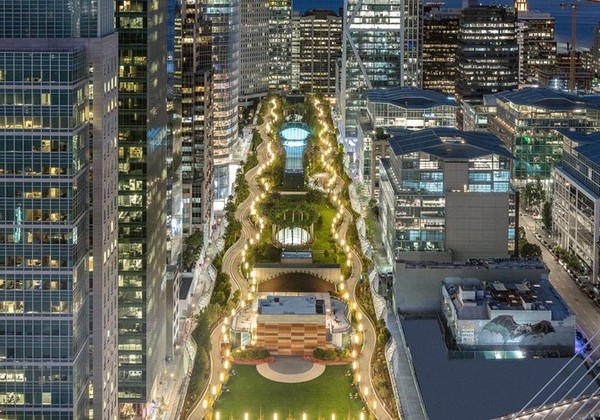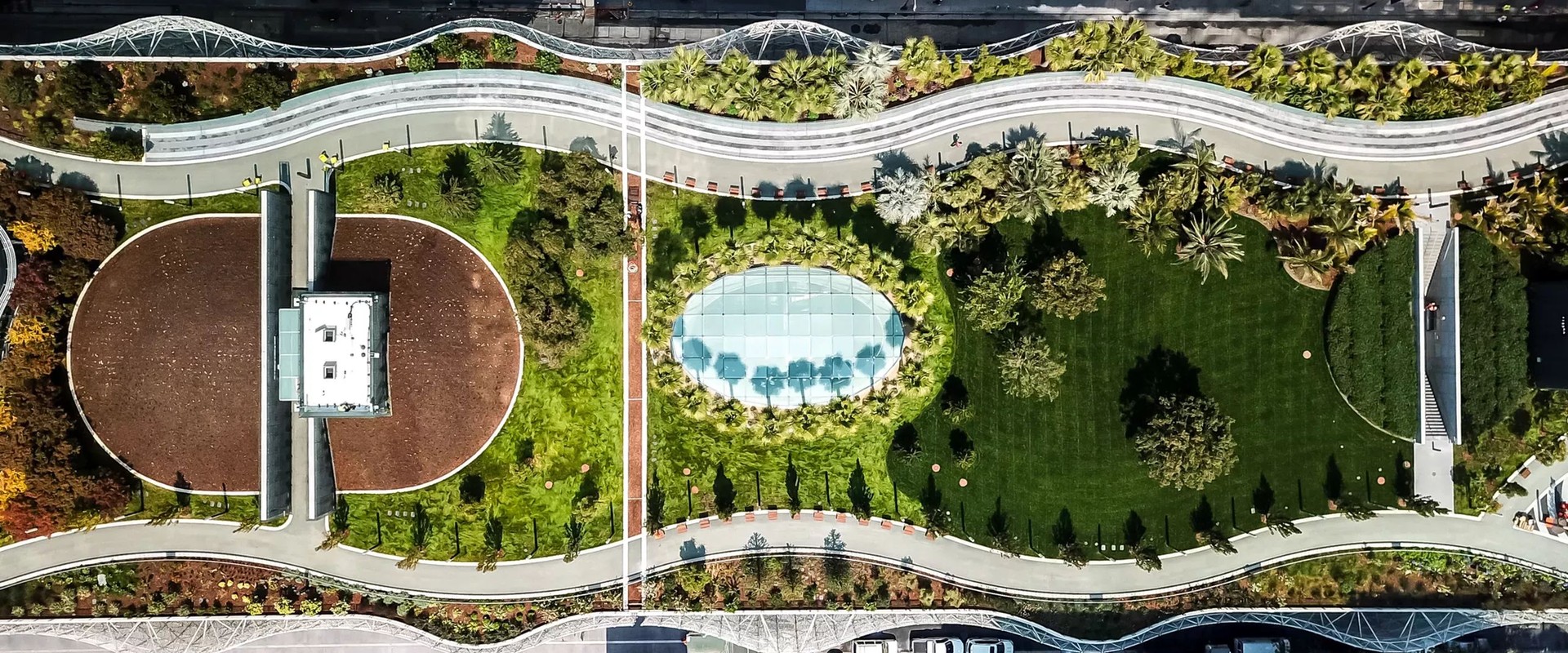
The Salesforce Park Transit Center in downtown San Francisco began as a transport infrastructure project and became a demonstration of how systemic design reveals solutions that conventional approaches would never consider. The SiD process identified that the optimal solution for a transit hub was a 2.2-hectare elevated public park.
Salesforce Park: When Systemic Analysis Redefines the Brief
The challenge
The original Transbay Terminal was a mid-century bus station that had become structurally and functionally obsolete. The redevelopment brief focused on transit capacity: more buses, future rail connection, better passenger flow. The systemic question was larger: what does this site need to do for the neighbourhood, the city, and the regional transport network simultaneously?
Systemic approach
SiD's full-spectrum analysis revealed that the highest-leverage intervention was not maximising transit capacity but creating ecological and social infrastructure above the transit functions. The rooftop park recycles rainwater for irrigation, builds urban biodiversity in a district that had almost none, provides public green space in one of the densest commercial areas in the western United States, and generates measurable uplift in surrounding real estate values.
The ELSI analysis showed that the park's contribution to individual wellbeing and to ecosystem health outweighed the value of additional commercial floor area that a conventional design would have placed on the rooftop.
Results
Salesforce Park demonstrates one of SiD's core principles: systemic analysis changes not just how you solve a problem, but what problem you solve. By analysing the site as a node in urban, ecological, and social systems rather than as a standalone transport facility, the design produced an outcome that serves multiple system-level functions simultaneously.