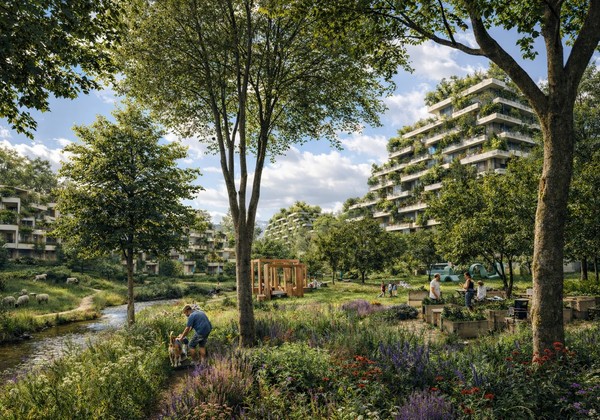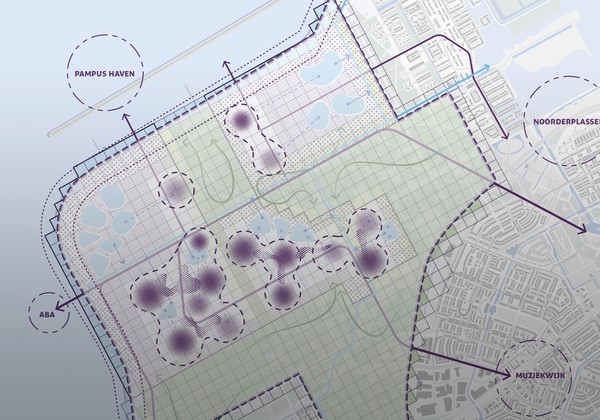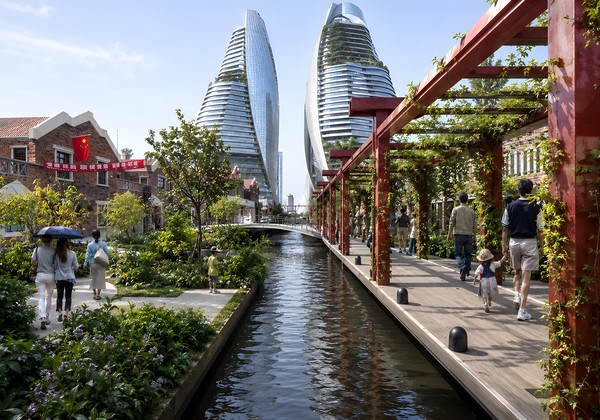
Orchid City is a comprehensive masterplan for a 40,000-resident sustainable district, designed using the full SiD methodology. The project demonstrates how systemic design operates at urban scale: coordinating energy infrastructure, water management, biodiversity corridors, mobility networks, governance structures, and social programming into a single integrated concept.
Orchid City: Systemic Design at Urban Scale
The challenge
The brief called for a district that could function as a self-sustaining urban ecosystem: net-positive in energy, water-neutral, biodiversity-enhancing, and socially cohesive. Standard masterplanning approaches address these as separate workstreams. The interdependencies between them are where the real design leverage exists, and where conventional methods fail.
Systemic approach
The SiD ELSI analysis revealed that the relationship between food production, water management, and energy generation created a symbiotic triangle that conventional zoning would break apart. By designing these systems as an integrated metabolism rather than separate utilities, the district achieves resource efficiency that no amount of individual building optimisation could match.
The SNO hierarchy structured the design at three scales simultaneously: the district system (boundaries, flows, governance), the neighbourhood networks (shared infrastructure, social spaces, mobility), and the building objects (orientation, materials, program). Decisions at each level were tested against system-level indicators for resilience, autonomy, and harmony.
Results
The masterplan delivers a district where waste from one function feeds another, where green infrastructure provides both ecological services and recreational value, and where governance structures enable residents to participate in resource management. The design has been presented internationally as a reference for integrated sustainable urbanism.